Assessment Framework

CROPS Scalability Assessment
Framework

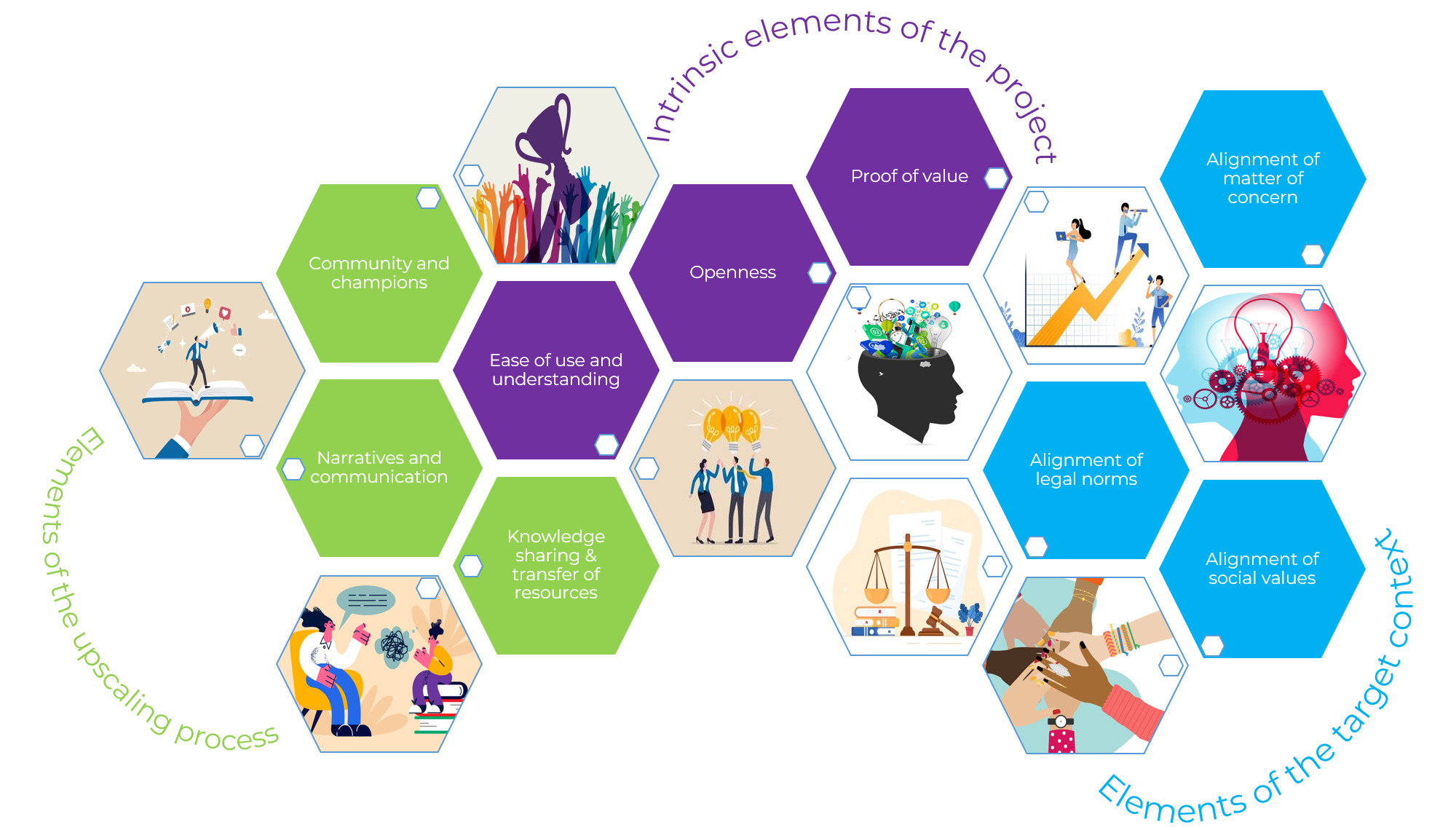
What are the factors that influence upscaling of CS projects? In other words, what elements should be searched, ordered, and considered when assessing the upscaling potential of CS projects?

Despite the growing demonstrated impact of Citizen Science and its more and more acknowledged value to address several pressing issues we face globally and locally as a society, too often it struggles to achieve sustainability and move beyond local actions and impact. The CROPS Scalability Assessment Framework focuses on upscaling Citizen Science at the transnational level. It does so in the context of the 5 EU Missions: Adaptation to Climate Change; Cancer; Restore our Ocean and Waters by 2030; 100 Climate-Neutral and Smart Cities by 2030; and A Soil Deal for Europe.
My image

Elements of the upscaling process

  • Community and champions

    Upscaling citizen science requires more than just technology transfer; it demands the artful work of aligning actors and fostering continuous engagement (Maccani et al., 2020). Project expansion is influenced by established communities and the presence of Champions within the "ecosystem of agents" (Bristol Approach to Citizen Sensing Programme, 2016). Consequently, CROPS includes work dedicated to creating transnational CS communities and identifying and engaging these crucial Champions.

  • Narratives and communication

    The communicability of a citizen science project heavily influences its upscaling potential. Many projects fail to be replicated simply because their information is not publicly available. Therefore, documenting a project's methodology, principles, and results in an appropriate manner, consistent with open science principles, is crucial for its adoption and expansion. This transparency is central to the work conducted in CROPS.

  • Knowledge sharing & transfer of resources

    This dimension highlights how Knowledge Sharing and Transfer Resources facilitate upscaling by moving expertise between contexts. In citizen science, these resources exist at three levels: (1) Inventories of projects; (2) Best Practices, Education, and Training frameworks; and (3) Toolkits containing guidelines and tutorials. The availability and accessibility of these resources - which provide access to methods for involving citizens, designing studies, and interpreting complex data - is critical to a project's upscaling potential.

Intrinsic elements of the project

  • Ease of use and understanding

    This construct stresses that a project's potential to upscale is highly influenced by its usability and comprehensibility. The easier a project's subject matter and core components are to use and understand, the more likely it is to expand. This relates to "task granularity" - the smallest effort required for a participant to contribute (Benkler, 2006). Simpler concepts (like mapping quiet places in urban spaces) scale more readily than complex scientific problems. While complex technologies can be used, they require different resources and co-design practices (Balestrini et al., 2014) to attract diverse participants.

  • Openness

    This construct asserts that a project's potential to upscale is strongly linked to the openness of its outputs (Fraisl et al., 2023). Open documentation - covering methodology, resources, and technology - increases engagement (Teli et al., 2015), fosters scalability (Marttila and Botero, 2013), and promotes shareability (Lessig, 2004). This includes opening up the process (guides), the tools (software/hardware), and the results (open data). As CROPS is committed to open science, this transparency is critically important.

  • Proof of value

    This construct posits that demonstrable impact significantly influences a citizen science project's potential to upscale. For a project to successfully expand, the value of its outcome must be present or emerging, clear, and well-understood. According to theory, this is the most influential driver. In CROPS, this Proof of Value is specifically defined as a demonstrated or emerging impact on one or more of the five EU Missions.

Elements of the target context

  • Alignment of matter of concern

    This element emphasises that the new context must face similar issues as the original project for upscaling to occur. Individuals must also perceive these issues as relevant matters of concern. Some highly context-specific projects, such as Tick Radar, are not suitable for transnational upscaling. Projects may also lack the maturity or intrinsic motivation to address EU-wide goals, preferring to solve local issues. In these cases, however, upscaling can still happen through replication mechanisms, where other stakeholders adopt and extend the project's legacy into different contexts.

  • Alignment of legal norms

    This element highlights the vital role of the regulatory environment in upscaling. For expansion to be successful, the regulations governing the initial and new contexts must be aligned. For instance, the WeCount citizen science project, which uses camera-based sensors for traffic counting, faced legal challenges when implemented across five EU cities. The lack of alignment on CCTV-based regulations across member states created a significant barrier to delivering the project's technology in all intended locations.

  • Alignment of social values

    Social values, like a strong culture of democratic participation, must be aligned between the original and target contexts for upscaling. For example, the Social Credit System in China, which uses Citizen Generated Data to develop individual "credit scores," is not replicable in Europe. This is because it requires coupling with people's ID, and as such is inconsistent with the shared European social values of equality and inclusion that are promoted through democratic processes.

Read more …Assessment Framework

  • Hits: 1106

Resources

CROPS Scaling Resources for the EU Missions

A diverse and evolving collection of curated resources aligned with each EU mission including toolkits, methodologies, guides, journal articles, case studies, conference proceedings, and more to support the uspcaling of citizen science projects.

Latest resources

Read more …Resources

  • Hits: 1568

Join the CROPS community

Join the CROPS community!

We invite you to be part of this transformative movement. Whether you’re launching a project, looking for strategies to expand, or eager to engage with like-minded individuals, there’s a place for you in the CROPS community.

CROPS aspires to inform and evolve the EU Research & Innovation system so that it can adequately support the transition of citizen science from small-scale to a Europe-wide level, moving it towards a modern, open-science approach. It will identify the most suitable citizen science initiatives for upscaling to the Europe-wide level, and in doing so will develop protocols, resources and examples of best practice for the upscaling of citizen science activities, helping practitioners to fully realise the potential impact of their activities towards the Horizon Europe EU Missions. This support will be tailored to all different types of citizen science, and the different stakeholders that are involved and participation taken. CROPS will also help citizen science practitioners consider inclusivity, public trust and societal impact, whilst being fully aware of data interoperability requirements, sustainability issues and funding approaches when upscaling their activities. 

Through becoming a part of the CROPS family you can:

  • Become a founding member of the CROPS Transnational Communities for each EU Mission
  • Become a member of the CROPS Special Interest Group (SIG) and get a chance to influence the European Commission’s work on upscaling citizen science
  • Access CROPS resources and guidance for upscaling citizen science projects
  • Contribute to and be credited in the CROPS outputs, e.g., scientific papers, policy papers, MOOC, etc.
  • Get a chance to be featured in the CROPS outputs, e.g., the MOOC, training resources, interviews, citizen science champions work, live events such as webinars
  • Extend your networks and learn from others’ experiences on upscaling citizen science

Join us! Please click here to show your interest and join the CROPS family!    

Read more …Join the CROPS community

  • Hits: 973

Climate-neutral and smart cities

Climate-neutral and Smart Cities

Cities play a pivotal role in achieving climate neutrality by 2050, the goal of the European Green Deal. They take up only 4% of the EU’s land area, but they are home to 75% of EU citizens. Furthermore, cities consume over 65% of the world’s energy and account for more than 70% of global CO2 emissions.

Since climate mitigation is heavily dependent on urban action, we need to support cities in accelerating their green and digital transformation. In particular, European cities can substantially contribute to the Green Deal target of reducing emissions by 55% by 2030 and, in more practical terms, to offer cleaner air, safer transport and less congestion and noise to their citizens.

The Cities Mission will involve local authorities, citizens, businesses, investors as well as regional and national authorities to

  1. Deliver 100 climate-neutral and smart cities by 2030 
  2. Ensure that these cities act as experimentation and innovation hubs to enable all European cities to follow suit by 2050 
  • Apollon: Towards a citizen science methodology for urban environmental monitoring

    Journal publication

    This journal article details the Apollon platform, a citizen science methodology for urban environmental monitoring that leverages mobile crowd sensing (MCS) and ICT technologies. It demonstrates how scalable citizen science initiatives can be achieved through the integration of low-cost sensors, mobile devices, and cloud computing, enabling widespread participation and real-time data collection. The platform's architecture supports both opportunistic and participatory sensing, making it adaptable to diverse urban contexts and capable of engaging large communities in environmental monitoring efforts.

    Read more

  • Citizen sensing: A toolkit

    Toolkit

    This toolkit provides a comprehensive guide to scaling citizen science through participatory environmental monitoring. The toolkit emphasises the use of open-source software and hardware, digital maker practices, and community-led sensing strategies to empower citizens in addressing local environmental challenges. By outlining structured processes for community building, data collection, and action, it offers scalable methodologies adaptable to diverse social and geographical contexts.

    Read more

  • How to anticipate constraints on upscaling inclusive Living Lab experiments

    Report

    This resource analyses constraints and opportunities for scaling up Urban Living Lab experiments, offering valuable insights for citizen science. It identifies barriers such as limited social inclusion, fragmented institutional frameworks, and underutilized learning potential, and provides strategies to overcome these challenges. By addressing these issues, the resource supports the broader adoption of citizen science practices in urban contexts, promoting inclusive and sustainable innovations.

    Read more

  • CitiObs Citizen Observatory Participation Dynamics Toolkit

    Toolkit

    This toolkit is a practical resource that supports the scaling of citizen science in climate-neutral and smart cities by helping project leaders manage stakeholder dynamics, build trust, and improve participation within Citizen Observatories. By addressing issues such as conflicting expectations, governance complexity, and data uptake, the toolkit strengthens collaboration and increases the potential for citizen-generated data to influence urban policy and climate action.

    Read more

  • MOSAIC Cookbook for co-creation

    Cookbook

    The MOSAIC Cookbook provides a structured, hands-on methodology for engaging citizens and stakeholders in co-creation processes that align with the EU Mission for Climate-Neutral and Smart Cities. By offering practical tools for ideation, prototyping, and local adaptation, tested in cities like Gothenburg and Milan, it supports participatory innovations within urban governance frameworks and smart city strategies.

    Read more

  • A Comprehensive Review of Citizen Science Projects for behavioral change towards sustainable urban environments

    Journal article

    This journal article analyses 83 EU-funded projects to identify key design principles, engagement strategies, and digital tools that foster behavioral change and policy impact in urban settings. By offering insights into co-creation methods, the Quadruple Helix model, and scalable citizen engagement frameworks, it serves as a practical guide for embedding citizen science into sustainable city development and urban governance.

    Read more

Read more …Climate-neutral and smart cities

  • Hits: 1204

A soil deal for Europe

A Soil Deal for Europe

The main goal of the Mission 'A Soil Deal for Europe' is to establish 100 living labs and lighthouses to lead the transition towards healthy soils by 2030.

Life on Earth depends on healthy soils. Soil is the foundation of our food systems. It provides clean water and habitats for biodiversity while contributing to climate resilience. It supports our cultural heritage and landscapes and is the basis of our economy and prosperity.

However, it is estimated that between 60 and 70% of EU soils are unhealthy. Soil is a fragile resource that needs to be carefully managed and safeguarded for future generations. One centimetre of soil can take hundreds of years to form, but can be lost in just a single rainstorm or industrial incident.

  • Citizen science & soil connectivity: Where are we?

    Journal publication

    This journal article reviews over fifty citizen science initiatives focused on soil connectivity, illustrating the scalability of such projects through diverse global examples. The article emphasises how simplifying scientific methods, leveraging technology (like smartphone apps), and fostering continuous communication with participants can enhance engagement and data collection across varied demographics. The study demonstrates that these strategies not only expand participation but also contribute significantly to environmental education and policy development.

    Read more

  • The role of citizen science in meeting SDG targets around soil health

    Journal publication

    This journal article reviews various citizen science methods and platforms that can complement traditional soil monitoring to meet Sustainable Development Goals (SDGs) related to soil health. By identifying cost-effective, accessible, and reliable tools for monitoring soil indicators like structure, organic carbon, and biodiversity, it highlights scalable approaches for engaging farmers and the public in large-scale data collection. This contributes to building comprehensive soil health databases that inform national and international policies.

    Read more

  • Citizen Science for Soil Monitoring and Protection in Europe: Insights from the PREPSOIL Project Under the European Soil Mission

    Journal article

    This journal article from the PREPSOIL project synthesizes data from 96 initiatives and provides actionable guidance on standardizing protocols, integrating remote sensing, and enhancing data quality and volunteer engagement to lay out a robust, policy-aligned framework for expanding citizen-led soil monitoring across Europe.

    Read more

  • Methods to leverage citizen science methods for soils

    Report

    This report from the ECHO project is systematically evaluates and selects the most suitable, user-friendly, and scientifically robust citizen science methods for soil monitoring across diverse European contexts. By offering tested toolkits, quality criteria, and recommendations for harmonisation and adaptability, it provides a practical foundation for building large-scale, high-impact citizen science initiatives that align with the EU Mission “A Soil Deal for Europe.”

    Read more

  • Participatory soil citizen science: An unexploited resource for European soil research

    Journal article

    This journal article reviews 24 European projects, identifies key success factors like co-creation, long-term engagement, and data openness, and proposes harmonised, scalable approaches providing a strategic guide for expanding high-quality citizen science initiatives that support soil health monitoring, biodiversity tracking, and policy alignment.

    Read more

Read more …A soil deal for Europe

  • Hits: 1233